
Hydro jet drain cleaning
Simpsonville SC —
4,000 PSI clears what
a snake leaves behind.
Professional hydro jet drain cleaning for Simpsonville, Mauldin, Fountain Inn, Taylors, and Greer. Camera before we jet — always. We confirm the pipe can handle high pressure before we run it. Same pricing 24 hours a day.
- Camera inspection before jetting — confirms safe pipe conditions and identifies root source
- Up to 4,000 PSI — clears root masses, grease, mineral scale, and debris snakes compress
- Recommended after jetting: CIPP assessment to seal root entry joints permanently
- 24/7 availability — zero after-hours surcharge on hydro jetting service
- Written estimate before work — no surprises on the invoice
Free Assessment
Ask about hydro jetting for your Simpsonville lateral
📞 (864) 474-4318📋 Free Written Estimate- Camera before we jet — always
- Written estimate before any work
- Zero after-hours surcharge, ever
- Same-day available including weekends
- Serving Golden Strip since 2005
hydro jetting service
loblolly root masses
confirms pipe condition
day or night
A snake cuts the blockage. High-pressure water removes it.
A mechanical drain snake — the cable-and-auger tool most plumbers default to — works by boring through a blockage and pulling it back, or by breaking a root mass enough for water to move through again. It’s fast and inexpensive. It also leaves the pipe walls coated with whatever caused the blockage, and it compresses root masses rather than extracting them. That’s why snaking provides temporary relief and the problem comes back.
Hydro jetting uses a high-pressure water stream — up to 4,000 PSI through a specialized nozzle — to scour the pipe wall clean. The rear-facing jets propel the nozzle forward while the forward-facing jet cuts through and flushes blockage ahead of it. Root masses, grease accumulation, mineral scale, and compacted debris are flushed completely through the lateral to the main. The pipe wall is left as close to original interior diameter as the technology can achieve.
The difference matters most in Simpsonville’s pre-1990 housing stock, where loblolly pine and sweetgum root masses are the dominant cause of lateral restriction. Snaking a root mass resets the clock by 6–18 months. Hydro jetting removes the mass entirely — and combined with a post-jetting camera inspection and CIPP assessment, you can identify and seal the joint the roots entered through, ending the cycle permanently.
Hydro jetting will clear the mass more thoroughly than a snake — but it doesn’t seal the joint the roots entered through. To end the cycle permanently, the right sequence is: camera to locate the entry joint, hydro jet to clear the mass, then CIPP assessment to determine if the joint can be lined. If it can, one CIPP job seals it and roots can’t re-enter. Your neighbor is right that jetting is better than snaking. The full answer is jetting followed by CIPP.
⚠️ We do not hydro jet without a camera first. High-pressure jetting on a pipe with structural damage — advanced Orangeburg delamination, a compromised wall section, a crack — can cause that section to fail during jetting. Pre-1973 Simpsonville homes and any home where the pipe condition is unknown get a camera inspection before the jet rig comes in. This protects your pipe and our work.
What hydro jetting removes
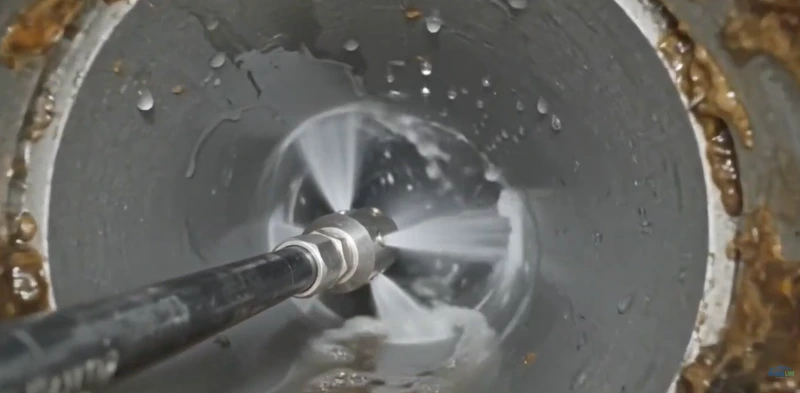
High-pressure hydro jetting at a Simpsonville lateral cleanout
In Simpsonville’s specific housing stock, here’s what we find and remove:
The dominant cause of pre-1990 Simpsonville lateral restriction. Dense fibrous masses at displaced bell-and-spigot joints. Hydro jetting at 3,000–4,000 PSI cuts through and flushes root material completely.
In kitchen laterals and areas near the kitchen stack, grease (fats, oils, greases — FOG) coats pipe walls over years. A snake passes through it. Jetting scours the wall back to near-original diameter.
Hard water mineral deposits in older clay laterals restrict flow progressively. Jetting removes scale that snaking can’t address.
Low spots in the lateral accumulate solids that build up into near-complete blockages. Jetting flushes what has accumulated, though it doesn’t fix the belly’s grade issue.
When snaking is sufficient vs. when you need jetting
| Situation | Right Tool |
|---|---|
| First-time backup, no prior history | Camera + snake to assess + clear |
| Recurring backup (2+ times in 2 years) | Camera + hydro jet + CIPP assessment |
| Dense loblolly root mass confirmed on camera | Hydro jetting required |
| Grease-coated kitchen lateral | Hydro jetting required |
| Pre-1973 Simpsonville home, pipe unknown | Camera first — no jetting without it |
Every hydro jet job in Simpsonville follows this sequence
Camera inspection
Before the jet rig is even on site, the camera goes in. We confirm: pipe material (clay vs. PVC vs. Orangeburg), structural condition (no compromised wall sections that could fail under pressure), blockage type and location, and whether root intrusion has reached the main connection. Pre-jetting camera is not optional in our process — it protects your pipe and ensures the jetting is targeted correctly.
Pressure selection
Not every pipe needs 4,000 PSI. Older clay with thinning walls gets lower initial pressure with step-up testing. PVC in good condition handles full pressure directly. Orangeburg — if confirmed still structurally viable — gets gentle pressure and close monitoring. We calibrate to what the camera showed, not to a standard setting.
Forward pass — cut and flush
The nozzle enters through the cleanout and works forward toward the main. Forward-facing jets cut through blockage; rear-facing jets propel the nozzle and flush loosened material toward the main. Root masses are broken apart and flushed. Grease is emulsified. The nozzle passes through the full lateral length.
Reverse pass — wall scour
On the pull-back pass, the rear-facing jets at full pressure scour the pipe wall. This removes the wall coating that snaking leaves behind — the grease film, the compressed root fiber, the mineral layer. The pipe interior is restored to near-original diameter by the time the nozzle exits.
Post-jetting camera
We run the camera again after jetting. This confirms the blockage is fully cleared, gives us a clean view of any structural issues that were obscured by debris before jetting, and identifies the entry joints that allowed root intrusion in. This post-jetting camera is the basis for any CIPP assessment that follows.
CIPP assessment — making it permanent
If the post-jetting camera shows viable pipe walls at the root entry joints, we offer a CIPP lining assessment while we’re already on site. Lining the joint that allowed root intrusion means the roots can’t re-enter. This turns a recurring jetting cost into a one-time fix. We explain the option, quote it in writing, and let you decide.
Hydro jetting works — but it doesn’t seal the joint the roots entered through. If loblolly or sweetgum roots found a displaced bell joint in your lateral, they were cleared by the jetting and then regrew through the same opening. Two years is typical regrowth time for root masses in Greenville County’s clay soil. The permanent answer is jetting to clear, followed by camera to locate the entry joint, followed by CIPP to seal it. That sequence is what ends the cycle. Jetting alone buys time.
Why the tree species and pipe age in your ZIP code determine how we jet
Five Forks and Kilgore Farms
Dominant tree species: loblolly pine, 25–40 years old. Most root intrusion finds lateral joints at 20–45 feet from the cleanout. We jet at sustained high pressure and always assess CIPP viability on pre-1995 clay laterals in these neighborhoods. Dense loblolly canopy means root re-intrusion through an unsealed joint happens within 12–24 months. CIPP after jetting is the right sequence here.
Mauldin — Butler Road and Grandview areas
1970–1990 construction with clay laterals now 35–55 years old. Sweetgum trees in the Mauldin residential grid are aggressive and shallow-rooted — they reach lateral joints faster than loblolly and from shorter distances. Hydro jetting at 3,500–4,000 PSI for established sweetgum intrusion, followed by camera confirmation. MetroConnects zone — single-home backup is your lateral.
Fountain Inn — Bryson Street corridor
Sweetgum and water oak are Fountain Inn’s primary root intrusion species. The Reedy River watershed position means higher year-round soil moisture, which accelerates root growth toward lateral joints. Pre-1990 Bryson Street homes have been our most common repeat jetting customers — until they add CIPP to seal the entry joint permanently.
Taylors — Pelham Road and Wade Hampton
The Metropolitan Sewer Sub-District serves Taylors. Pre-1990 construction with loblolly canopy planted at the 1968–1988 development boom — now fully mature at 37–57 years. Highest root intrusion density we find anywhere in Greenville County, confirmed in 7 of 10 pre-1990 camera inspections. Post-Helene inspections near Brushy Creek have shown elevated root entry through new offset joints.
Downtown Simpsonville — pre-1973 zone
We do not hydro jet pre-1973 Simpsonville laterals without a camera inspection first. The Orangeburg pipe probability in the SE Main Street corridor, City Hall adjacent blocks, and Woodside Mill area is high. Orangeburg in advanced delamination cannot tolerate high-pressure jetting — the water pressure can cause immediate wall collapse. Camera first, always, in this zone.
Greer — Tanner Road and Suber Road areas
Greer sits on the Greenville-Spartanburg county line with MetroConnects and Greer CPW service territory overlap. Pre-1990 construction in the Tanner Road corridor has mature loblolly intrusion at rates comparable to Five Forks. Post-Helene soil movement near creek corridors has created new offset joint opportunities for root entry. Camera-first jetting with CIPP assessment offered in the same visit.
What hydro jetting costs in Simpsonville SC
Based on 46 completed Greenville County jobs. Camera inspection is priced separately and precedes every jetting job.
| Service | Typical Range |
|---|---|
| Camera Inspection Required before jetting, written report included | $150–$300 |
| Hydro Jetting — Standard Lateral Root mass and debris clearing, typical Simpsonville lateral | $300–$600 |
| Hydro Jetting — Heavy Root / Grease Dense established root masses or severe FOG accumulation | $500–$800 |
| CIPP Spot Liner After Jetting Seals root entry joint permanently, prevents regrowth | $1,200–$3,000 |
Written estimate before any work. No Simpsonville trip charge. Same rate 24/7. Price on estimate = price on invoice.
“John was able to bust through our clog with the sewer jetter. Very professional and friendly. We will use this company if we need them again.”
“We had root intrusion coming back every year. After jetting and CIPP lining the entry joint, two years later — zero issues. Should have done it three snake jobs earlier. Would have been cheaper overall.”
“They walked me through the root of the problem. How to correct it so they don’t need to come back and gave me other information to help me understand my sewage needs.”
What Simpsonville homeowners ask before scheduling
Is hydro jetting safe for older clay pipes in Simpsonville?
Yes — with the camera inspection done first. Healthy clay pipe handles jetting well. The risk is in pipe with structural compromise: thinning walls, advanced Orangeburg delamination, or cracks. The camera identifies these conditions before the jet rig comes in. If the camera shows a pipe that can’t safely tolerate high pressure, we tell you that and recommend the right alternative. We calibrate jetting pressure to what the camera showed, not to a fixed default setting.
Will hydro jetting stop root intrusion permanently?
Jetting alone won’t stop root intrusion permanently — it clears the existing root mass but leaves the joint the roots entered through open for regrowth. In Simpsonville’s clay soil with mature loblolly pine root systems, that regrowth typically takes 12–24 months. The permanent solution is jetting to clear the mass, then CIPP lining to seal the entry joint. The liner creates a continuous jointless pipe interior — no gaps for roots to find. That combination ends the cycle permanently.
How is hydro jetting different from snaking?
A mechanical snake (drain auger) bores through blockage or breaks root masses apart, allowing water to pass. It doesn’t clean the pipe walls and it compresses root fiber rather than removing it. Hydro jetting uses high-pressure water at up to 4,000 PSI to cut through blockage, flush it completely out of the lateral, and scour the pipe wall back to near-original diameter. The difference shows up in longevity: a snaked root mass returns in 6–12 months. A jetted and cleared lateral with no CIPP follow-up typically stays clear for 18–36 months. A jetted + CIPP-lined joint is permanent.
Can you hydro jet the same day I call?
In most cases, yes. We need to run the camera first — which typically happens the same day as the jetting. If we’re already responding to a backup emergency, the camera is part of the same visit. Same-day scheduling is available across Simpsonville, Mauldin, Fountain Inn, Taylors, and Greer. We do not operate a next-week scheduling window for active backup situations.
Do I need hydro jetting or just a camera inspection?
Start with the camera inspection. The camera will show you exactly what the blockage is, where it is, and how severe it is. If the camera confirms a root mass or heavy grease accumulation that snaking wouldn’t clear effectively, we recommend hydro jetting based on what we saw — not as a default upsell. If the blockage is simple debris or a soft clog that a snake can clear, we tell you that and save you the jetting cost. The camera is $150–$300. It determines what comes next.
Camera first. High-pressure clear. CIPP to make it permanent.
Serving Simpsonville, Mauldin, Fountain Inn, Taylors, and Greer. Same-day hydro jetting available. No trip charge. Same rate 24/7.
📞 Call (864) 474-4318 Get a Free Estimate